

So you’ve recently started your first job as a junior doctor. Congrats! Being a junior doctor is hard work and comes with plenty of extra responsibility. But it also comes with a few perks along the way, like salary sacrificing.
Done right, salary sacrificing can help you take home more money without working extra shifts. Here’s how it works and how to make sure you don’t miss out.
How does salary packaging work?
Salary packaging for doctors (sometimes called salary sacrificing) is a way to use part of your income before tax. Instead of paying tax on all of your pay, you can put some of it towards certain everyday expenses, like rent, loans, or credit cards.
If you’re a medical employees of a public hospital, charity or not-for-profit, you have the option of salary packaging certain living expenses and meal entertainment expenses. The tax savings you’re receiving from salary packaging is the Fringe Benefit Tax (FBT) which public hospital and not-for-profit employers are exempt from paying.[CW1]
As a junior doctor in a public hospital, you can usually claim up to:
- $9,010 per year on living expenses (rent, loans, credit card repayments).
- $2,650 per year on meals and entertainment (dinners out, venue hire like for weddings or Christenings, hotels or Airbnb).
Think of it as using pre-tax money for things you’d already be paying for anyway.
There are two main ways to claim:
- Receipt method – collect receipts, submit them, and get reimbursed from your hospital administrator.
- Card method – load money onto a special card and use it like a debit card for eligible expenses.
One thing to keep in mind: you can’t claim for drinks without a meal, meals for one, takeaway meals and restaurant vouchers.
You can also package other FBT-free benefits, like work-related expenses, computers and personal electronic devices. Depending on where you work, there may be restrictions and various terms and conditions.
Why should doctors do salary sacrificing?
The biggest perk? More money in your pocket.
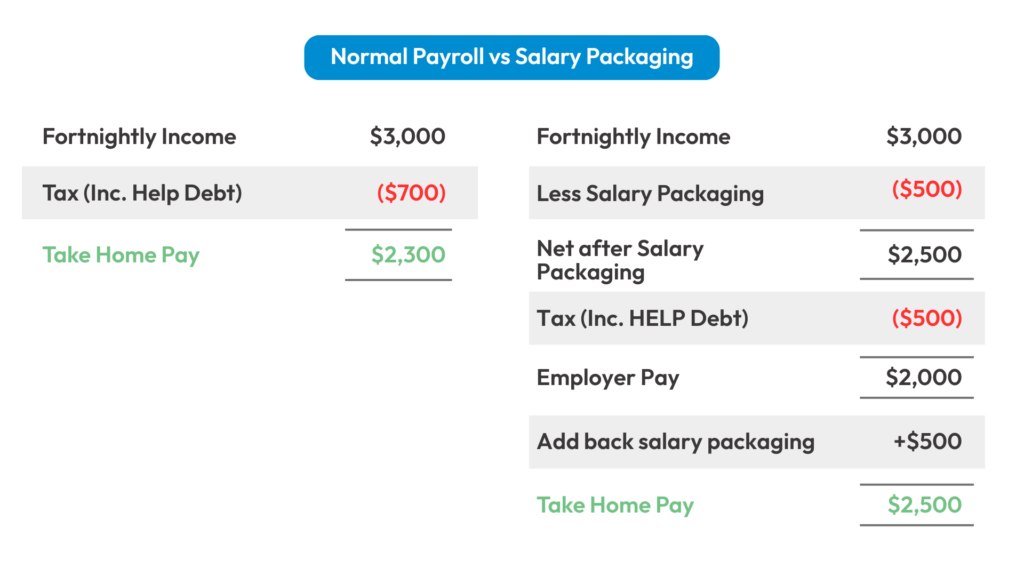
Here’s a simple example:
- Doctor A earns $3,000 a fortnight. They pay $700 tax and take home $2,300.
- Doctor B earns the same, but salary packages $500. They only get taxed on $2,500, so their tax drops to $500. Once reimbursed, their take-home pay is $2,500.
That’s an extra $200 every fortnight or around $5,000 a year.
It’s designed to keep doctors in the public system and reward you for the hard work you’re doing.
Common mistakes to avoid
Mixing up the dates
Salary packaging doesn’t follow the usual financial year. Instead, it runs with the fringe benefit tax year, which is from April 1 to March 31 each year.
Keep in mind that the reportable fringe benefit amount on your income statement for the financial year (1 July to 30 June) is the grossed-up taxable value of the reportable benefits provided in the previous FBT year (1 April to 31 March).
That means if you leave an employer between April and July, you may still show a reportable fringe benefit amount on your Income Statement for the following year, even if you earned nothing from them in that financial year. During your intern year, this also means you might package at two different tax rates as it falls over two different financial years.
It can be a bit confusing so chat to your accountant about planning around your rotations so you can take full advantage of this benefit.
Waiting too long to sign up
Don’t make this mistake! Get the benefits ASAP and sign up as soon as you start working for a new employer. Your employer should give you details about what you can claim, how to sign up and how to log expenses when you receive your employment contract.
Salary packaging super
It’s probably not a good idea to salary sacrifice your extra super payments because you can actually claim it as a tax deduction from your tax return to reduce your tax even further. It may also be a consideration to receive advice around salary sacrificing to superannuation, as this provides the ability to increase your super balance while also receiving a tax deduction.
Assuming every public hospital is the same
Each public hospital has different rules for what you can and can’t package. You might find with one employer, you can claim something that another doesn’t allow.
When should you review salary packaging options?
Even once you’ve set it up, it’s worth checking in now and then:
- Are you close to the cap?
- Has your roster or hospital changed?
- Is it still working for your financial goals?
A quick review can save you from paying extra tax or missing out on benefits.
Salary packaging isn’t complicated once you know the basics. For junior doctors, it can mean thousands of extra dollars a year, money that’s especially handy when you’re starting out.
Next step: Chat to a DPM tax advisor. We’ll walk you through the setup, help you avoid common mistakes, and make sure you’re getting every dollar you’re entitled to.
This article contains general advice only and may not be suitable for your circumstances. Make sure you seek financial advice appropriate to your individual circumstances before making decisions.