


Starting internship comes with plenty to organise, from hospital orientation to getting used to your first roster. Salary packaging might not be at the top of your list – but understanding it before your first pay could make a difference.
If you’re starting internship at an eligible hospital in January, your first year will span two salary packaging years. This means you may have access to two annual caps, although how much you can use will depend on your circumstances and your employer’s rules.
The reason comes down to timing. Internships generally start in January, but the salary packaging year resets on 1 April. Those first ten or so weeks come with an annual cap of their own. Interns who spend that time sorting paperwork may miss the opportunity to use some of that first cap.
This article explains how the two caps work, why the first one can go unused, and what interns can do to prepare before January.
Salary packaging at a glance
Salary packaging lets you pay some eligible everyday expenses with your pre-tax salary. This reduces your taxable salary, which can increase your take-home pay.
Eligible public and not-for-profit hospitals can offer this because they receive different Fringe Benefits Tax (FBT) treatment from many other employers. The FBT exemption cap for these hospitals is $17,000 per employee per FBT year in grossed-up value. In practical terms, that generally works out to about $9,010 of eligible living expenses you can pay using pre-tax salary.
Common expenses you maybe able to package include:
- Rent or mortgage repayments
- Credit card repayments
- Loan repayments
On top of that, you get a separate allowance of about $2,650 for eligible meal entertainment, such as restaurant meals, repay venue hire and accommodation.
You generally need to be employed by an eligible hospital that offers salary packaging to access these benefits. So as a student on placement, you can’t package. As an intern on the payroll, you can.
You only get access once a public or non-profit hospital employs you. As a student on placement, you can’t package. As an intern on the payroll, you can.
The two caps in your intern year
Your internship year overlaps two Fringe Benefit Tax (FBT) years, so you may have access to two full caps.
The FBT year runs from 1 April to 31 March, not January to December. Your cap belongs to the FBT year, and the law does not shrink it if you start halfway through. So when you start in January, you get a full cap for the rest of that FBT year. Then on 1 April, a new cap starts.
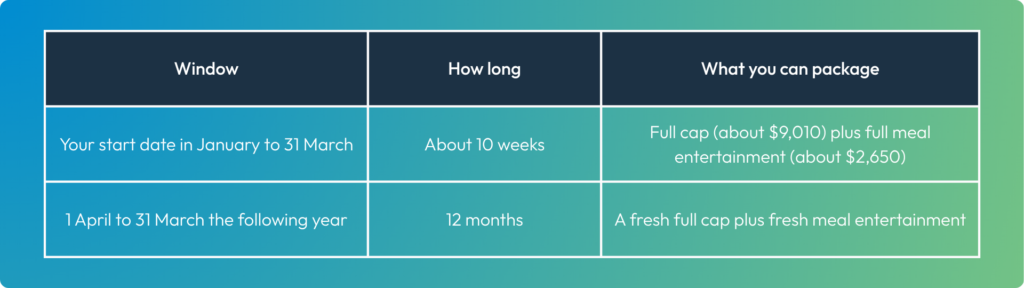
*Any cap you don’t use by 31 March disappears. It does not roll over.
In simple terms: the first window gives you a whole year’s allowance to use in about 10 weeks. Starting late leaves fewer pay cycles to use it.
Laptops and phones: a window that closes on 31 March 2027
Key date: From 1 April 2027, salary packaged laptops, phones and tablets will no longer be exempt from FBT. Interns starting in January 2027 may have one short window to use this benefit.
Under the current rules, public hospital staff may be able to salary package certain work-related items without FBT applying. These include portable electronic devices such as laptops, mobile phones and tablets, provided they meet the relevant eligibility and work-use requirements. Packaging rules generally allow one item of each type per FBT year, and providers usually treat these items separately from the main cap.
That changes soon from I April 2027. According to the ATO guidance, the work-related item exemption generally will not apply to items provided through salary sacrifice. The change covers:
- Portable electronic devices (laptops, mobile phones, tablets)
- Computer software
- Protective clothing
- Briefcases
- Tools of trade
The change comes alongside the new standard deduction of up to $1,000 for work-related expenses.
What this means for 2027 interns: the January to 31 March 2027 window may be the only chance to package a work laptop or phone FBT-free. Eligibility, timing and payment rules vary by employer and provided, so check the details before making a purchase.
Talk to us before 31 March 2027 to learn more about how this change may apply to you.
Why the first cap often goes unused
Admin, not tax law, can be one reason the first cap goes unused. Each hospital runs salary packaging through its own provider, with its own forms, rules and timelines. The first weeks of internship are busy, so the paperwork can easily sit untouched.
The setup process typically involves these steps:
- Identifying the provider. Each health service picks its own salary packaging provider.
- Reviewing the employer’s policy. Hospitals set their own rules on how much staff can package per pay and which expenses they accept.
- Registering with the provider and signing a salary packaging agreement.
- Supplying proof of expenses, such as a lease, loan statements or credit card details.
- Waiting for payroll to process it. The first packaged pay often lands weeks after sign-up.
Salary sacrifice arrangements generally need to be in place before you earn the salary being sacrificed. Starting the process early gives you more time and pay cycles to use the first cap.
Interns starting in Victoria
Victoria has no single statewide scheme. Each health service (Monash Health, Austin Health, Western Health and so on) can choose its own provider and set its own policy. Setup steps differ depending on the hospital or health service that employs you.
Staff who work across more than one health service may have access to a cap with each employer. Each service’s packaging provider can confirm these details.
Interns starting in NSW
HealthShare NSW provides information about salary packaging. NSW interns deal with one provider and one set of rules, which generally makes setup simpler.
NSW Health also shares the tax saving with its staff. The Sydney Children’s Hospitals Network explains that NSW Health splits the saving 50/50 with employees. Packaging still increases take-home pay, but staff keep roughly half of the tax saved.
Final-year medical students in NSW who work as paid Assistants in Medicine may already be eligible to package. Their employer’s payroll team can confirm their eligibility and how any benefits already packaged affect the cap available when they start internship.
Key considerations
Salary packaging can increase an intern’s take-home pay, but several factors affect how much they gain. Whether it suits you depends on your circumstances.
1. Cash flow in the first window. Using the full expenses cap in about 10 weeks means packaging roughly $900 a week, excluding any meal entertainment benefit. An intern’s pay and expenses may not stretch that far. Some interns may use part of the first cap and all of the second.
2. HELP repayments. Packaged benefits appear on an employee’s income statement as a reportable fringe benefit. The ATO adds that amount to income when it calculates HELP repayments. For many people the tax saving outweighs the extra repayment, but the outcome varies from person to person.
3. Employer rules. Some hospitals limit how much staff can package per pay or which expenses they accept. These rules can affect how much of the first cap an intern can use.
Because these factors differ between individuals and hospitals, there is no single right amount to package.
A pre-internship checklist
You may find it useful to work through these steps before your first shift.
- Confirm which hospital or health service will employ you.
- Find out which salary packaging provider that hospital uses.
- Read the hospital’s salary packaging policy.
- List the expenses that could be packaged (such as rent, loans or credit card repayments).
- Gather proof of those expenses (such as lease or statements).
- Learn how packaging interacts with HELP repayments.
- Note the 31 March deadline for the first cap and the meal entertainment allowance.
- Ask when the provider’s forms can be lodged and when payroll deductions can begin.
Want to learn more?
DPM works with doctors and medical professionals across Australia. If you want to understand how salary packaging works at public hospitals, you can book an initial consultation with the DPM team to talk it through.
Book a free initial consultation with us
Starting internship soon? Our Intern Package service supports interns with tax and accounting matters specific to medical careers, from the first year of work through to specialty training. Book a time with one of our Tax Consultants here.
Sources:
- ATO: Public hospitals, non-profit hospitals and public ambulance services
- HealthShare NSW: Salary packaging
- Sydney Children’s Hospitals Network: Salary packaging
- NSW Health: Assistant in Medicine FAQs
- Maxxia: I work in health, how much can I salary package?
Disclaimer: The information contained in this article is general in nature and does not take into account your personal objectives, financial situation or needs. Before acting on this information, you should carefully consider whether it is appropriate for your circumstances and seek professional advice.
This article is published by Doquile Perrett Meade Pty Ltd (DPM Financial Services). Doquile Perrett Meade Pty Ltd is the promoting entity and the provider of the tax and accounting services referred to in this article.
Liability limited by a scheme approved under Professional Standards Legislation.